« How much does a kilo of vanilla beans cost? » It is one of the questions I am asked most often by pastry chefs, ice cream makers and home bakers. The short answer: it depends. The useful answer is this article. I am Arnaud Sion, founder of Le Comptoir de Toamasina; I have worked with vanilla since 2010 and have lived in Brazil since 2015. Here I explain what drives the price per kilo, how the market got where it is today, and how to turn a price per kilo into a real cost per bean and per recipe.
A price per kilo means nothing unless you know exactly what you are buying. A kilo of short, dry extraction-grade beans and a kilo of 18 cm gourmet beans are not the same product. Before comparing prices, compare grades, lengths and moisture.
How much do vanilla beans cost per kilo today?
In 2026, vanilla export prices are among the lowest of the past decade. Madagascar, which supplies roughly 75 to 80 % of the world’s natural vanilla, enforces a minimum export price: black (gourmet) vanilla cannot leave the country below about 50 US dollars per kilo, and lower grades have even lower floors. Good gourmet beans trade above that floor, depending on length, moisture and volume.
Retail is a completely different market. When you buy a few beans or 100 grams online, the price includes selection, airtight packaging, freight, import duties and shipping. It is normal for a retail price per kilo to be several times the export price you read about in the trade press.
| Market | What it is | Order of magnitude |
|---|---|---|
| Madagascar export (black) | FOB price between exporters and professional importers | Official floor around 50 US$/kg in 2026, more for gourmet |
| Export (lower grades) | Extraction beans, cuts, short beans | Well below black vanilla |
| Retail | Price paid by consumers, per bean or small quantities | Several times the export price |
Why did vanilla prices soar and then collapse?
In 2014, Madagascar gourmet vanilla still traded at export for roughly 35 to 65 dollars per kilo. From 2015, strong demand, largely from food manufacturers switching from synthetic vanillin back to natural vanilla, met a limited supply. Cyclone Enawo, which struck the Sava growing region in March 2017, destroyed a large share of the vines. Speculation and theft in the plantations did the rest: by 2018, gourmet beans were trading between 500 and 800 dollars per kilo.
Those prices encouraged new planting worldwide. Since a vanilla vine takes about three years to bear fruit, the new supply arrived just as manufacturers had moved back to substitutes. Prices fell year after year. In 2020, Madagascar introduced a 250-dollar minimum export price to support the sector, but stocks piled up and the floor was dropped in 2023. Prices quickly returned to historic lows, with a far more modest floor.
From about 50 US$/kg in 2014 to over 500 US$/kg in 2018, and back to about 50 US$/kg at export in 2026: vanilla moves in long cycles driven by Madagascar’s climate, industrial demand and the three years a vine needs to produce.
What makes one kilo of vanilla more expensive than another?
Grade. Black, or gourmet, vanilla is the most expensive. Red vanilla, meant for extracts, costs much less, and cuts even less.
Length. The longer the bean, the higher the price per kilo. Beans of 18 cm and more are rare and prized; 12 to 14 cm beans are cheaper and often just as fragrant.
Moisture. A gourmet bean contains about 30 to 38 % moisture. Part of the weight you pay for is water, but that moisture is what keeps the bean supple and its aromas alive.
Maturity and curing. A bean harvested ripe and properly cured over several months develops far more aroma. Early harvests, common when prices are high and theft rises, give handsome beans with little flavour.
Origin. Tahitian vanilla, produced in small quantities, usually costs more than Madagascar vanilla. See my guide which vanilla origin to choose.

How many beans are in a kilo, and what does a recipe cost?
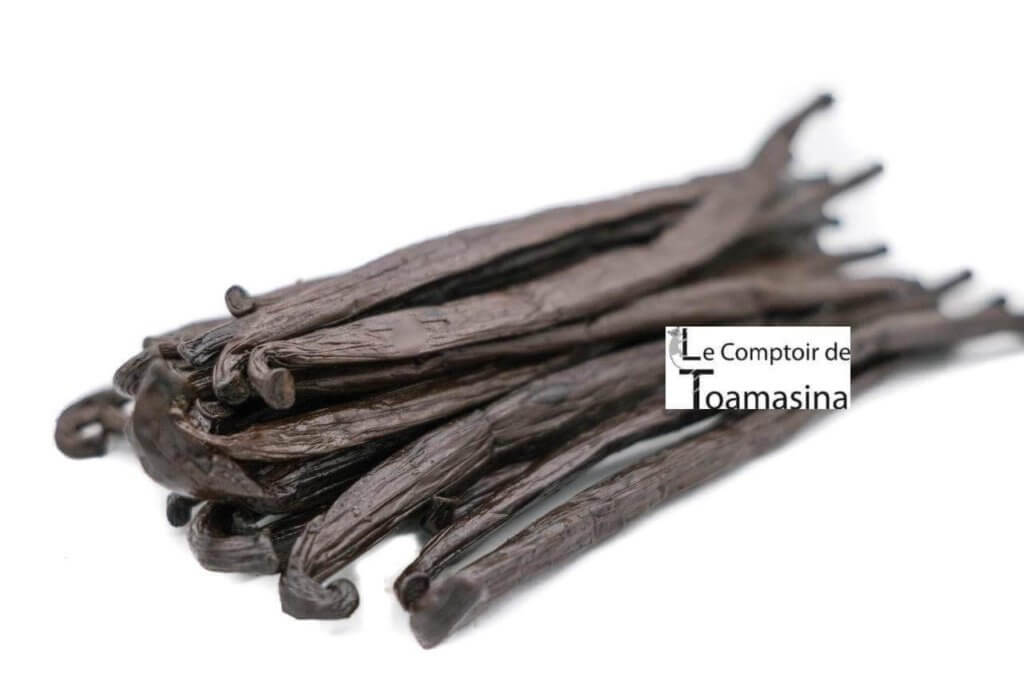
A 16 to 18 cm gourmet bean from Madagascar weighs on average 3 to 5 grams, so a kilo holds roughly 200 to 300 beans. Tahitian beans are thicker and heavier, so there are fewer per kilo; dry red beans are lighter, so there are more.
To find the real cost, divide the price per kilo by the number of beans, then by the number of servings. A crème brûlée for six uses one bean: with 250 beans per kilo, each serving uses 1/1500 of a kilo of vanilla. Even with premium beans, that is a small cost for a huge difference in taste. As a guide, use half to one bean per 500 ml of milk or cream, and one bean per litre of ice cream base.
What does the price buy in terms of flavour?
Ultimately, what you buy by the kilo is a fragrance. A well-cured Madagascar bean holds hundreds of aromatic molecules, well beyond vanillin. Here is how I describe it, and how it compares with other origins.
Aromatic pyramid of Madagascar Bourbon vanilla
Indicative comparative profile (scale of 0 to 5)
Frequently asked questions about vanilla prices
See our vanilla beans